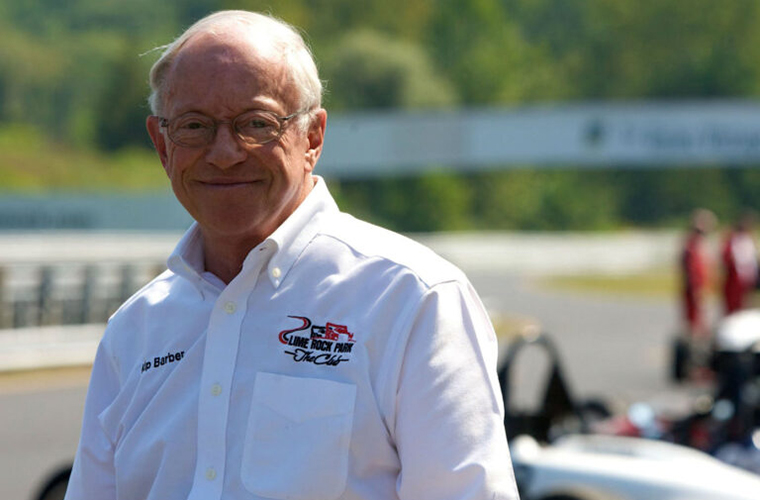

Born in the Philadelphia area, Skip Barber, always a “car guy,” managed to race while a senior at Harvard in the late 1950s. He won the very first race he entered. In his first professional race, Skip led world champion Jim Clark in an identical Lotus 23 for 190 miles; it was the car, not the driver, which couldn’t manage the final 10 miles. Skip eventually became one of just a handful of Americans to reach Formula 1. He placed seventh in his first Grand Prix, but his other six starts, the insufficiently funded car failed. Without a ride for 1975, he temporarily left the cockpit to open up the Skip Barber Racing School, which went on to huge success and continues today under new ownership. It was in the mid-1980s that Skip first acquired a financial interest in the historic race track Lime Rock Park and in 1999, after selling the racing school, he claimed full ownership of Lime Rock Park. And, his creation of the Lime Rock Drivers Club in 2008 continues to provide the finest members-only driving facility in North America.
Q: How and when did your love of cars and racing begin?
A: I grew up in the 1950s, in a family where cars were very important. My grandfather had owned a Ford dealership, and my father loved cars. When I was about 10, we lived in Philadelphia, and there was an alley about a block long behind our house and our neighbors’ houses. Someone had left a very old car in my parent’s garage, and they allowed me, at that very young age, to drive it up and down the alley. There was a road at both ends of the alley, and I wasn’t allowed to take the car out onto the road. So I logged exactly as many miles going forward as I did driving in reverse, and that was a LOT of miles. My love for driving began in that alley.
Q: What was the most memorable moment from your racing career? What prompted you to stop?
A: My most memorable achievement as a driver was the first national championship I won from the Sports Car Club of America. In the 50s and 60s, the SCCA was a widely known and highly respected racing organization. The organization still exists, but today there are many more professional and semiprofessional classes of racing, so it’s not as well known anymore. I’m also one of very few Americans to ever compete in a Formula 1 World Championship. I had qualified on the pole at Daytona my first championship weekend. Late in the day we discovered that the motor had serious problems and needed to be rebuilt. This was terribly complicated because it involved getting the block to Boston for machine work and getting a piston out of a Ford warehouse in Detroit. This was difficult because this was Thanksgiving weekend. We rebuilt the motor at the racetrack and finished just in time for the Sunday morning warm up. I was passing a car in the warmup when it slid into me and my car was totally destroyed. With only a couple hours before the race, we had to prepare a second car, which included taking the motor out of the first car. I was sitting on the grid in pole position when an SCCA official came up to me and said, “Sorry. This isn’t the car you qualified. Go to the back of the grid.” I successfully argued that it was the same motor, which was the most important thing at Daytona, and went back to the front of the grid. Then a protest by the guy who was in second position sent me to the back of the grid again. You can imagine the satisfaction when I won the race. Actually, I crushed them. Then the mechanics who had been up all night building the engine had to take it apart for the SCCA inspectors. My racing career ended when an entrant for whom I was to drive a Formula 5000 car changed his mind at the last minute about running that season. It was too late to do anything else and I had started my racing school that year. It seemed logical to focus on the school rather than racing.
Q: Are today’s professional race car drivers any different from previous generations?
A: I’m not sure that there’s any great difference in drivers over the years. Being wealthy has always been a huge asset, but ultimately you have to be fast. It is easier to get started if you have resources, but there are many examples of champions who started with nothing. Drivers at the highest level of racing sometimes bring the money, which may not be their own, but they get the ride because they have sponsorships. This is certainly true of the teams in the back of the grid in Grand Prix racing. I was not a good promoter of myself when I was racing. But by the time I had the racing school, I had become a good marketing guy, because I was selling the school and not myself, but that was too late for racing. Apart from the financial aspects, race car driving has always required a very high degree of athleticism. To succeed on any track, drivers must be coordinated and have really good vision. In the past, poor vision could end a driver’s career, but most drivers today have eye surgery to correct any issues.
Q: What are your favorite marques, and why?
A: I have a small car collection, partly thanks to Mitch Katz at PFS. I’m not a champion of any one particular marque. I have two 1960s era Ferraris, for example, but I don’t get any more pleasure driving the Ferraris than I do driving my 1961 Porsche. The price of a car has nothing to do with the pleasure of driving it. If I had to keep only one car, the Porsche is the one I would select, because I really enjoy driving it.
Q: What’s the outlook for interest in racing, given the growth of autonomous cars?
A: Some argue that autonomous cars will be wonderful for race tracks because eventually Big Brother will restrict your speed limit, and goodness knows what else. So you can argue that those changes will be great for Lime Rock, because there will still be people who like fast cars, and there won’t be any other place to drive them. Right now, race tracks are used primarily by car clubs that host their own driver education programs. For example, Porsche clubs and BMW clubs use Lime Rock for their members. Companies like Porsche NA also sponsor events for their customers, giving them an opportunity to test drive the newest, most modern cars. That kind of participation is likely to grow. I’m not sure yet how these changes will affect people buying tickets to attend races, coming as spectators. Those are long-term issues, but what continues to frustrate me is people who enjoy cars and have never been to our race track. I think many people have misperceptions about racetracks and assume Lime Rock is about noise, grease and car crashes, typically associated with NASCAR race tracks. What’s important to understand is that Lime Rock is a park, with the most upscale audience you can imagine. It’s a beautiful place that makes a lot of many well-known golf clubs look shabby. Our spectators sit on blankets with a picnic basket and enjoy the experience, and if anyone comes here to see a crash, they’ll have a very long wait, because they are rare.