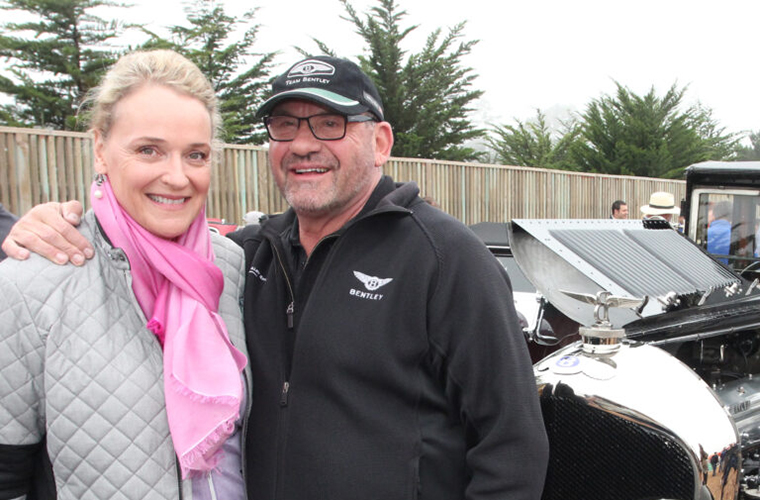


Martin Button is President of Cosdel International Transportation, overseeing the logistics and handling all the details involved in transporting collector cars to automotive events around the world. He serves as a member of the Selection Committee for the Pebble Beach Concours d’Elegance, is an announcer for the concours, and involved in its publications. He also officiates at many other concours. Martin and his wife, Sandra Button, have acquired an eclectic collection of automobiles ranging from a 1920 Stutz Roadster to a 1972 Ferrari 365 GTC/4, with a WO Bentley, a Vauxhall, five Jaguars and a Studebaker Avanti. They regularly participate in driving events such as the Copperstate 1000, the Millas Sport in Argentina, Rally Nippon in Japan and the Holy Land 1000 in Israel. Martin is also a member of several automotive organizations, including the Veteran Car Club of Great Britain, the Rolls Royce Owners Club, Bentley Drivers Club and the Classic Jaguar Association.
Q: How and when did your love of classic cars begin?
A: I started out as a motorcyclist. I bought my first bike when I was 14 and spent two years restoring it, until I was 16, and old enough to ride bikes in the UK. Before I was 17, I bought my first car, which was a Heinkel Trojan Bubble Car. In England you are allowed to drive a 3-wheeled vehicle on a motorcycle license. I had it for about a year, then I bought my first real car, and I’ve been into cars ever since.
Q: What’s the backstory regarding your ownership of Cosdel?
A: Cosdel was founded in 1960 by two guys (Cosmo and Delmar) from Chicago who moved out to the West Coast to begin exporting American food products, which in those days consisted mostly of canned fruit, walnuts, almonds and prunes. The company had nothing to do with cars. In 1980 I was attending graduate school in San Francisco and needed to earn money, so I applied for a part-time job at Cosdel as a freight forwarder. My interview with Cosmo consisted of one question: “Do you know what a letter of credit is?” I replied, “Yes.” And Cosmo said, “O.K. There’s your desk.” I bought the company, which was just me and one assistant, in 1982.
Q: How did Cosdel go from shipping canned fruit to shipping classic cars?
A: During that time I often visited Bruce Trenery at Fantasy Junction, a very well-known classic car dealership, to look at his inventory and kick the tires. One day Bruce asked me, “Can you ship cars?” Although we never had shipped cars, I told him that we could. A customer of his had just purchased two Ferraris, and wanted to ship them overseas. So we put them on a 40 foot container and handled all the logistics and paperwork. Our entry into the car shipment business was not by design, but it grew quickly as some of Bruce’s other customers began to use Cosdel to ship their cars overseas. That’s when I realized that the future for Cosdel was in shipping cars. So I started marketing and going to auctions to solicit business, and our reputation and client list grew from there. That’s also how I learned so much about classic cars. I would read auction catalogues from cover to cover, and I still read them as much as I can.
Q: How would you describe Cosdel’s market niche?
A: Our business is almost exclusively international shipping of classic cars. We handle all of the coordination details for people who have the financial means to want the very best treatment for their classic cars when they ship them around the world for a concours, rally or other events. Our clients are serious car collectors who are very busy, and don’t want to be bothered with the myriad of details involved in international shipping. They want the transaction to be invisible. Our clients only want the peace of mind and confidence that their cars will arrive safely whenever and wherever they want them. Cosdel is primarily a service company, and we are a one-stop shop. For example, we work hard to ensure that our clients can fly into their destination, and have their car waiting for them, with
a full tank of gasoline, air in the tires, and detailed if necessary. We call this our “Fly and Drive” service. We go the extra mile to make the experience as seamless as possible for the owners, so they can focus on having a good time. We take care of all the details.
Q: What are the most significant challenges in shipping classic cars?
A: Classic cars are works of art and shipping them can be a dangerous business. Risk can’t be eliminated entirely in shipping, because things can happen that are beyond our control. Our job is to minimize all the inherent dangers and risks involved in what we’re doing. We have a special insurance policy that covers a client’s car from the moment it’s under our care until we deliver it to the ultimate consignee. The insurance coverage we carry is extremely comprehensive, so that on the rare occasion that there is a claim, the car can be properly restored. If a shipper tells you there are no risks involved, they’re simply not being truthful. There will always be risks when shipping cars. But it’s what you do about problems, when they occur, that matters the most. That’s how Cosdel has built its reputation over the years.
Q: Can you provide an example of the lengths your company has gone to, in terms of client service?
A: There have been some interesting situations over the years. We’ve flown our staff members around the world on several occasions to hand carry paperwork through customs. We did that for the Holy Land 1000 – a rally event in Israel – where we shipped 36 cars. One of those cars was late leaving the U.S. because our client’s house had burned to the ground in the big Sonoma County wild fire. Miraculously, his garage was left untouched, but all of the paperwork necessary to export his cars to Israel had been destroyed in the house. This slowed down the shipment to the rally, and the car ended up in Valencia, Spain, potentially missing the rally in Israel. So we sent one of our staffers to Spain to take care of it, and our client’s car arrived in Tel Aviv around 8 o’clock at night, in time for the start of the rally early the next morning. More recently, we had a problem with a late delivery involving a car that was going from the U.S. to London, which we had planned to transport by truck to North Africa for a special event. There had been a mechanical breakdown on the plane, and there wasn’t sufficient time to truck the car to North Africa. So we chartered a plane and flew the car from London to Africa, and it was the only piece of cargo on the plane. We do whatever is necessary to meet and exceed our clients’ expectations.
Q: What’s a common mistake that people make in shipping their vehicles?
A: Not telling the truth is sometimes a problem. For example, a car’s gas tank needs to be almost empty, particularly if it’s being shipped by air. Sometimes, because the price of gas can be 5 or 6 times more expensive in Europe, some people will send the car with a full tank. This can be a costly mistake! On rare occasions, we’ve also had people hide contraband in their car. One car we shipped had $6 million worth of Ecstasy pills hidden inside the panels in the footwells of the vehicle. Dogs at Australian customs smelled the drugs, and that former customer is serving a long prison sentence.
Q: Is there any type of car that’s particularly difficult to ship?
A: If a car is going into a container, it needs to be securely blocked, braced and tied down. Some cars are more difficult to prepare for shipping than others. In those cases, we always make special accommodations. For example, we shipped David Sydorick’s 1937 Alfa Romeo 8C 2900B – which won Best of Show at Pebble Beach last year – to Paris for the Peninsula Hotel’s “Best of the Best Award.” That car has very large fender skirts, so we asked David if we could remove them for easier, safer shipping. David agreed, and he even had handmade slip covers constructed to protect the fender skirts while the car was in transit. We put the fender skirts on the car at the hotel, and took them off again when we shipped the car back to Los Angeles. Sometimes you have to go the extra mile.
Q: What’s your special connection with the Pebble Beach Concours?
A: This will be my wife Sandra’s 34th year associated with the Pebble Beach Concours, and she has served as the Chairman for the past 17 years. One of the things that continues to make Pebble Beach Concours so significant is its charitable giving program. Last year alone, the Pebble Beach Concours was able to raise $2.1 million for charity, and has given more than $28 million since Sandra has been Chairman. Most of the money is distributed to charities on the Monterey Peninsula. Our biggest recipient is the Boys & Girls Club of Monterey county. The Concours also provides scholarships related to automobile restoration, and sends students to McPherson College and the Academy of Art restoration program in San Francisco.