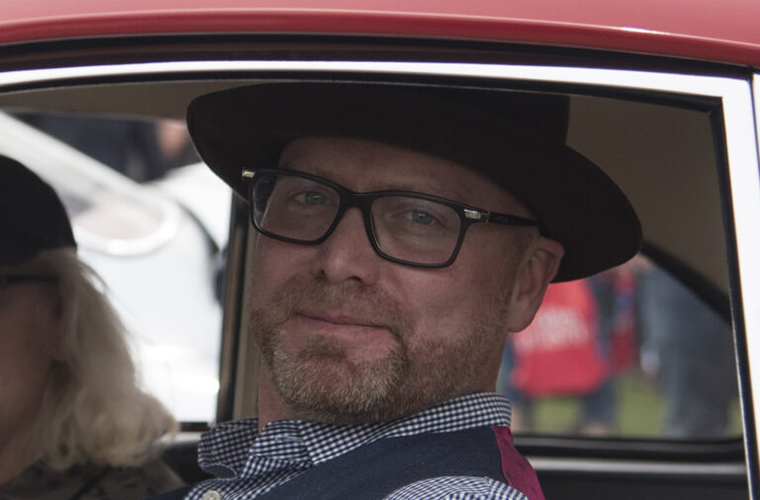

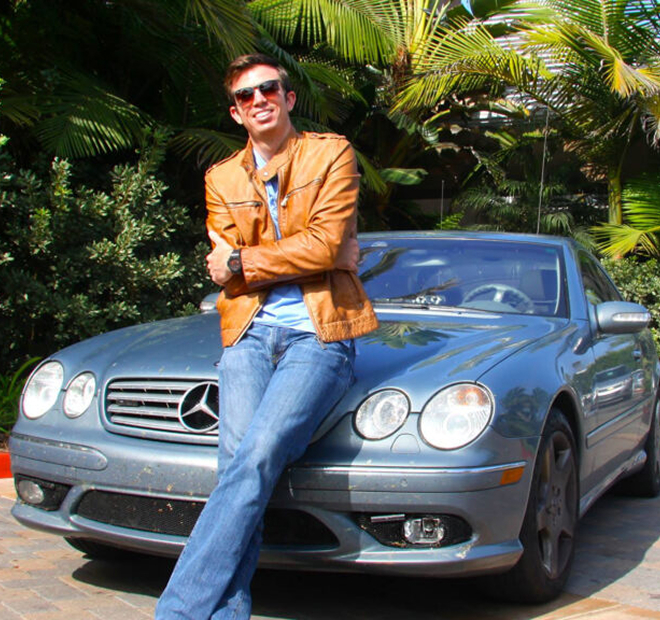
Cam Ingram is the owner of Road Scholars, an award-winning business specializing in restoring significant automobiles, managing Porsche collections for private clients, and selling some of the rarest automobiles in the world. With facilities on both the East and West coasts of the United States, Road Scholars’ work has become the gold standard for vintage Porsche restoration with over 74 Concours victories.
Cam Ingram’s background includes a Bachelor of Fine Arts in metal sculpture as well as a Bachelor of Business Administration, both earned in 2000 from Guilford College. Cam is the co-author of the book, “Porsche Unexpected: Discoveries in Collecting” and a contributing author of, “Porsche by Design: Seducing Speed.” Cam has been recognized and featured for his Porsche expertise on several classic automobile panel discussions and publications, which include: Forbes Magazine, The New York Times, The Wall Street Journal, Hagerty Insurance, Classic Porsche, and Excellence Magazine.
Q: Where did your love for Porsches come from?
A: I graduated from a small liberal arts college with BA degrees in fine arts and in business. Sculpture was my passion until my early 20s, and I wasn’t much of a car guy. It wasn’t until 1998, when my father took me to the Porsche’s 50th anniversary in Monterey, that I saw my first Porsche 356 coupe rolling down the road. At the time, I was studying bronze pouring, was really passionate about kinetic sculpture, and attempting to challenge people’s perspective of space with my sculpture. So when I saw this little 356 rolling down the road – which embodied the principles of Dr. Porsche, that form always follows function, it was love at first sight. That’s kind of how I got started. I came back to Greensboro, North Carolina and persuaded the owner of a Porsche restoration shop to hire me, and I worked there for 3 years.
Q: What’s the backstory on how you came to own Road Scholars?
A: After working at the restoration shop, in 2003 I did a short stint in a corporate job, but found that I didn’t have the appetite for large company bureaucracy. I wanted to get back to restoring cars, and that same year I met Kevin Watts, who had established Road Scholars with a partner in 1999. At that time, his partner needed to leave the business for personal reasons, and I purchased his ownership stake. For 17 years, I focused on building the restoration branch of the business and Kevin handled sales. Then in 2018, after a long successful partnership, Kevin decided that he wanted to pursue another venture and I am now the sole owner of Road Scholars. Sales and restorations are our two main business arms, and we also perform service for local VIP clients. We handle consignment sales, but sometimes we buy great low mileage cars and service them extensively, so they are ready to be sold and enjoyed by the next owner.
Q: What’s the typical cost of a full restoration?
A: When I sit down with a potential new client I have them go through a presentation to make them aware of the time and cost commitment that’s required, and to determine if their car is appropriate for restoration. Our average restoration cost is around $350,000, and that’s if the car has really solid bones and does not need extensive metal work or is not missing original parts. When you perform concours-level restoration work, those are the two most expensive endeavors during the process. If extensive metalwork is required, the restoration cost can quickly escalate to more than $500,000. An owner needs to ask if their car will be worth 7 figures. If you’re going to put at least $350,000 into a car, it had better justify a return on that investment. However, we have done some projects where
there is no expectation of a return on investment, where it makes no sense financially, but it’s an emotional decision. Those situations might involve a car that’s considered a family heirloom, or a legacy of its owner. Those are meaningful cars to do as well, because you are saving something that otherwise may not have been saved, and it’s a car that means something very special to someone.
Q: How important was the restoration work you did for the Porsche family?
A: It was a huge honor and privilege when Dr. Porsche asked if we would restore the 45th Porsche ever made. I think it was the first time that our company was really tested, because it was a process that lasted a year and a half. We understood the opportunity, and we lived in the shop during that project. It was a lot of pressure, and we really just wanted to be on the field at Pebble Beach and not embarrass ourselves. We did much better than that, and it was really a growing up opportunity for our company. That assignment was also very important for our reputation. It took place during the infancy of Facebook and Instagram, and we benefited from the viral nature of those social media platforms. I often wonder if we would enjoy the same level of exposure if were doing that assignment today.
Q: Why does the Ingram family hold Porsches in such high regard?
A: There are several reasons. It starts with the aesthetics and artistic appeal of their cars, which continue to be based on their founder’s vision regarding the role of design. The other major component is the engineering excellence. Porsche’s success has been built on a machine concept that should not work, featuring an engine that hangs over the top of the car’s rear axle, with a reputation as something that will not break. Another part of Porsche’s appeal is its versatility. You can compete with your Porsche at a local track, and then drive it home, which is something that you can’t do with many cars. I come from a hardworking family with humble beginnings in the Midwest, and we aren’t flashy or ostentatious, so Porsche’s dependability, usability and practical design resonates with us. In the world
that we live in today, in terms of evolving car technologies and self-driving vehicles, people are still looking for things with intrinsic worth and soul. I think that the Porsche brand is powerful because it unites people through that common passion.
Q: You don’t buy or sell at vintage car auctions. Why is that?
A: There is a marketplace for everybody, for every type of car. I think that collectors who want to buy a certain model car are better served by working with a subject matter expert or specialized shop, because there is often more of a longterm commitment and better business dynamic, compared with a one-off transaction at an auction. At some of the auctions, there is not complete transparency, and much of the good will in the car business is built on transparency. For example, when we sell a car, some people will ask us how much money we are making on the transaction. We believe that being transparent with people, in terms of revealing percentages and numbers, is a healthy thing. We’re happy to do that with potential buyers because it shows good faith that you are not taking advantage of anybody, and demonstrates that we stand behind our products. This is not something that’s regularly practiced in our industry, but it’s something that can improve its reputation.
Q: Do you see any generational shifts, when it comes to interest in specific marques?
A: Both Porsche and Ferrari are in a special place. Because they continue to make such compelling new products, they are not experiencing the same generational issues as Aston Martin, Alfa Romeo or some other exotic marques. In fact, what I see is a “reverse rabbit hole” effect. For example, a Millennial might purchase a new million-dollar 918 hybrid as their first Porsche, and then they’ll go backwards, and start to experience vintage, analog Porsches that represent different stages of the marque’s production. What they often discover in this process is that it’s much more fun to drive a slow car fast than it is to drive a fast car slow. It also helps that Porsche products are consistently usable across the board, from the 1950s right up to the current era. They are more user friendly in terms of dependability, but sometimes there can be a generational learning curve…like how to start a carbureted engine that’s been sitting for three months.
Q: Any words of advice for someone looking to buy their first Porsche?
A: I’m asked this question all the time. A smart first move into Porsche is the 996 generation Carreras, from 2000 – 2005, which are great, robust cars that are fun to drive. The 996 was the model, along with the Boxster, that saved Porsche and moved it into the modern era. If you can find a nice 996 Carrera or Carerra S, with the intermediate shaft bearing upgrade completed, they are bullet- proof cars, and can be really affordable. Their cost ranges from $18,000 to $30,000 depending on their condition. The 996s also have great resale value, because there are always people looking for a Porsche at the entry level.