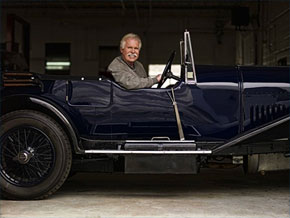

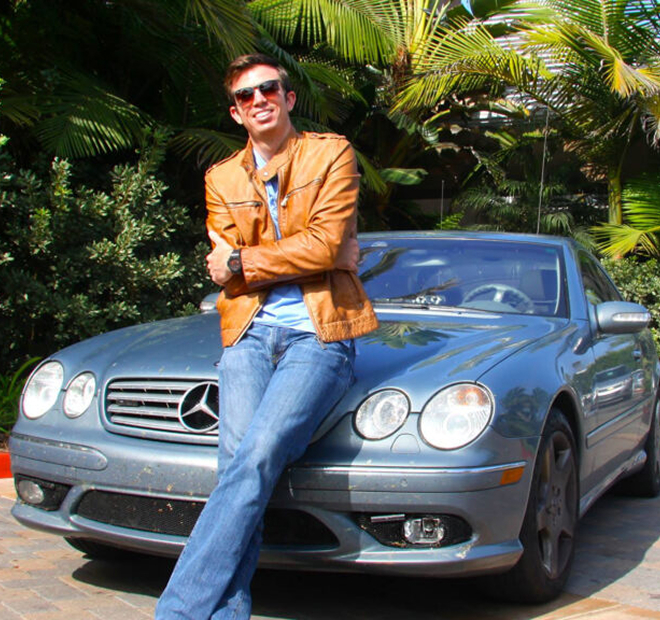
Wayne Carini has a lifetime of experience in automobile restoration, and a resume that includes work on rare car collections owned by the likes of David Letterman, tennis great Ivan Lendl and the DuPont family. He’s been featured in the New York Times as well as numerous automobile magazines, and starred in two one hour television specials. For the past decade, Wayne has been host of the highly acclaimed Chasing Classic Cars on the Velocity Channel, where he gives viewers an insider’s look into his personal mission to uncover the world’s most rare and exotic cars. At home Wayne is a dedicated father of two daughters and husband of 24 years. The family resides in rural Connecticut, in a log home that Wayne built 33 years ago.
Q: How do you account for the longterm success of Chasing Classic Cars?
A: Our show’s key ingredient is authenticity. There is no script. No one is acting. No one is arranging outcomes. It’s just me, reacting in real-time to whatever happens. It’s reality television in its purest form. We work hard to make the shows interesting, but sometimes they miss the mark. People are often surprised if I take a car to auction and lose money; but that’s what happens sometimes in real life. If you were a winner at auctions all the time, everyone would be a car dealer.
Q: Are there still lots of classic cars in barns waiting to be discovered?
A: There are still a lot of interesting cars out there, but it’s getting tougher to find them. The average collector looking for a hidden gem needs to be constantly looking. You need to let lots of people know that you’re interested, go to cars shows, and ask whether they know of any cars for sale, or any hidden treasures. You need to be persistent and track down every lead, because you never know what’s going to turn up, which is part of the fun. My dad and I used to look behind every house we drove by, and into every garage that was open. We found a lot of great cars that way As a serious car hunter, you also need to be prepared for disappointment. One deal that I worked on for 5 years – involving a Shelby Cobra and a Ferrari 275 in the Carolinas – was based on a tip from a neighbor, and included three visits to the owner’s home, many letters and fruit baskets. In another deal, for 3 years I paid the TV cable bill of a Lamborghini owner in Chicago, so that he could watch my show, in hopes of his being predisposed to sell me his car. Both deals fell through, but I enjoyed the pursuit, and always understand that losing is a part of the game.
Q: What’s the meaning behind the F-40 name, and why is your business located in such a remote part of Connecticut?
A: My business is called F40 Motorsports because at the time I started the company I owned a Ferrari F40, which celebrated Ferrari’s 40th anniversary and was the last model personally approved by Enzo Ferrari. I also wanted a simple name that people would remember, and that did not have the Carini name in it. Our company is located in Portland because it’s near Glastonbury, where I grew up. We think it’s a fantastic location, because we are 2 hours from both Boston and New York City. More importantly, we believe that if you offer something of value, then people will go out of their way to do business with you. Our inventory is unique, and we have cars that are not easily found anywhere else in the world. If you offer cars that are special, you don’t need to take them to Pebble Beach. You could sell them from a Walmart parking lot in Kansas.
Q: Can you provide a few tips for people who are newcomers to the car auction world?
A: First and foremost, buy a car that you like, and not what everybody else likes. Buy with your gut, rather than other people’s advice. Always do your own homework, because auctions are a tough place to buy cars for people who don’t really know cars very well. It’s also important to have a set price in mind for a car at an auction. I will often write the target price of a car on my hand, and then look at that hand right before I raise my bidding hand, so that I don’t go above my target. There may be certain cars that you feel you’ve got to own, and you will pay whatever it takes. But most of the time you need to have self-discipline, and that includes not bidding up a car based on emotion, or under the influence of adult beverages. I try to know who I’m bidding against, and if it’s a friend, I will either fold as a courtesy, or talk to them during the bidding. Auction houses frown on this practice, but I will try to find out if(s) he wants the car for their private collection, or intends to flip it. On some occasions, I’ll partner with a friend to buy a car that we intend to sell, and we’ll split the cost and whatever profit we make.
Q: If you were a 16 year-old today with $5,000 to buy an unrestored car with “classic” potential, what would you be looking for?
A: I’d be looking for something unusual or even weird, and not whatever everybody else is driving. I would look for the best unrestored unique car – an AMC Gremlin, Ford Escort or 64 Buick, for example – that my money can buy. And if you happen to buy a Mustang with an original 6-cylinder engine, don’t replace it, because it will make the car more interesting. When you go to a car show, or even park it at the mall, people will want to talk to you about your car, because they’ve either never or rarely seen one. Being able to talk about your car is a great way to grow your interest in car collecting.