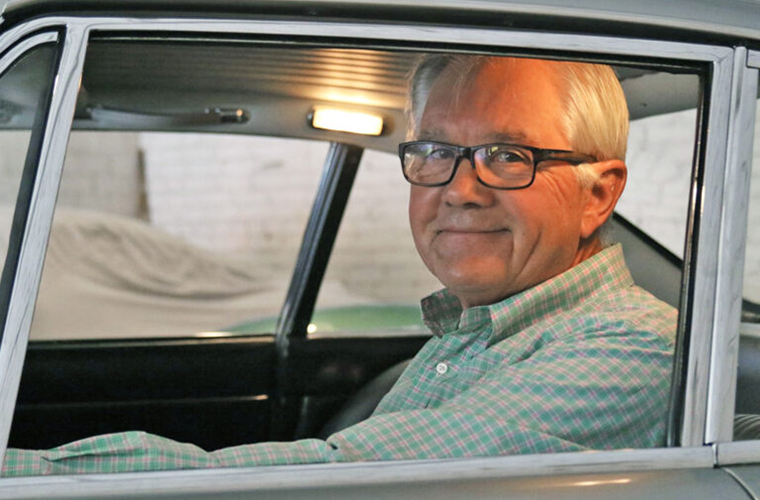

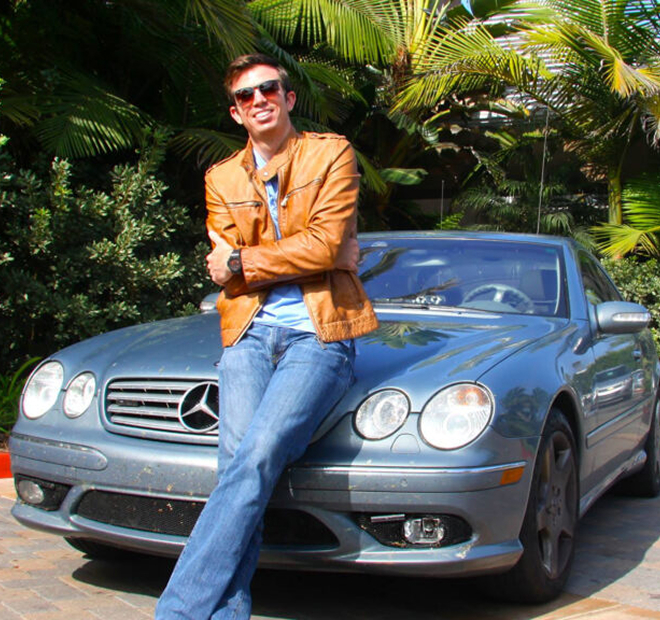
A native of Berkeley, California, Bruce has an A.A. in Business Administration and a B.A. in International Marketing. Bruce has been an automotive enthusiast all his life. He continues to race today, running everything from a Riley and Scott prototype at the Daytona 24 hours, an Acura Integra R at the Nurburgring 24 hours, to a 1935 Alfa-Romeo 8C35 Grand Prix car, Alfa Monza or a Lola T70 at the Monterey Historics. Whether pounding down the Mulsanne straight at LeMans in a Delehaye or Ferrari SWB, or watching his car get crushed by the organizers at the 24 Hours of Lemons, Bruce enjoys the competition to the fullest. Bruce also enjoys traveling the world with his eyes peeled for interesting automobiles in the most unlikely places, spending time in Europe, Asia, Africa, South America and the Middle East. Bruce often hosts many of the world’s largest collectors and dealers during the course of the year. In the last 43 years, Fantasy Junction has enjoyed an excellent worldwide reputation for straightforward honesty and knowledge in the collector car field.
Q: How and when did your love of cars begin?
A: I grew up in a California town right next to UC Berkeley. Perhaps because of the university’s international student body, or because the professors traveled overseas and brought cars back to the states, there were always a lot of interesting European cars – like Jaguar XK120s and AC Bristols – parked on the street and in driveways. So that sports car rich environment during the 1950s and 1960s was the catalyst for my life-long interest in sports cars.
Q: What’s the backstory on your car racing passion?
A: When I was a kid, my dad took me to the sports car races at the Oakland airport, so that’s probably where my passion for racing began. I read Road & Track, Car & Driver and all the car magazines. When I was really young, I raced go-karts, and then motorcycles for a short time, although I never finished a race because I always crashed. When I was 21, I started racing cars, but I didn’t have much money, so I raced “B” grade cars, starting with Formula V, then Formula C, and ultimately Formula B, before totally running out of money. I didn’t race very much from 1970 to 1979, because I was in the Marine Corps and then went to college; but since that time I’ve remained very involved in all kinds of events. For example, I’ve done the Nurburgring 24 Hour 12 times, ran 8 times in the Daytona 24 Hour, ran 5 times at Sebring, and ran the NASA 25 Hours at Thunder Hill around 15 times. My son, Spencer, shares my love for racing. At 17, he won the American Cities Racing League Sports 2000 championship, making him the youngest ever SCCA Pro Racing champion at the time.
Q: How and when did Fantasy Junction get started?
A: In 1976, I was selling cars for a Porsche dealer in Walnut Creek, when a friend of mine told me about a collector car company in Mill Valley called “Fantasy Junction” that was up for sale. The company had been started 9 months earlier by the owner of a local BMW dealership, but after losing money during that entire period, he wanted to get rid of it. So for $500, a partner and I bought his unprofitable business and moved it to a warehouse on a dead-end street in Berkeley, where we set up our folding chairs and waited for something to happen. There were several twists and turns to the Fantasy Junction story during its first year, but I ended up purchasing my partner’s stake in 1977, and served as sole owner of the company until 2018, when I turned over the business to my son, Spencer. Now he’s the boss, and I’m an employee.
Q: What’s Fantasy Junction’s business model?
A: We sell cars on consignment for customers, and we also buy those cars that we are confident will make money. Because we’ve built up a lot of trust over the past 44 years, we’ve been involved in the sale of many wonderful cars. They are consigned to us by owners who don’t want people coming to their house, or driving their cars, or haggling over the price. Many people would rather pay a small amount of money to someone like us – who sell cars all the time and know the market value of their particular car – so that they get a fair price for it. Our goal is to have all parties feel they got a fair deal. Sellers need to feel they were paid a reasonable amount of money for their car, and buyers need to feel they were not overcharged. We work on what we consider to be a fairly small percentage for all the work it takes to market and sell a car, so our goal is to sell a lot of cars. We are extremely careful with other peoples’ cars. Our buildings are earthquake resistant, and we have fire sprinklers, case hardened locks on the doors, and all keys are kept in a safe. We don’t have an in-house mechanical shop, because it would be impossible to be competent with all the different marques we handle. So we take cars to specialists for each model, to make sure that whatever work is required to get them ready for sale is performed correctly.
Q: Are more transactions done online, versus in person?
A: Most of our business is now done online. This continues to surprise me, not only because I’m “old school,” but also because most of the cars we sell are 40 or 50 years old. I understand that most people don’t want to take the time to jump on an airplane, but I always recommend that people try to come see the car for themselves, and to drive it. When we started the company, we prided ourselves in supplying the big dealers in Switzerland, England, Germany, Italy and Japan. They would fly over and look at the cars and have them checked out firsthand. But now those dealers rarely visit; instead they will call us and ask, “How does this car compare with the car I bought from you in 1996?” We might tell them, “The car we sold you in 1996 was a “10,” and this car is a “9.” Boom, the deal is done, and everyone knows what to expect when that car comes out of the container. Our reputation has increased the confidence people need to buy our cars online, without seeing them in person.
Q: How many cars do you typically keep in inventory?
A: We never keep any more than 60 cars in inventory, which is based on the size of our building. Some people ask if we will sell their cars on our website only, but the problem is that we can’t see it or show it to a potential buyer, and the logistics of sending a buyer to an owner’s house to see the car are very difficult. We try to have all the cars right here, so we can evaluate them and write the description as accurately as possible, explaining the good and the bad about the car. We take exhaustive photographs, and are able to answer detailed questions. For example, someone may ask us about a Corvette, “What color is the second hand on the clock?” to determine whether it’s from a 1966 or 1967. If the car is not here we can’t provide them with that information. We try to have 60 cars in stock at all times.
Q: How long does it take to sell a car?
A: We try to move cars within 60 days. If the market’s going up, they will shoot out of here. That was the case from 2010 to 2014, when the market was increasing around 20% a year. But since that time, it’s been reducing. It was easy to move cars during that earlier period, because everyone was trying to gain control of an asset before prices went higher. But now, when prices are dropping, people wonder if a car will be less expensive if they wait. Nobody is in a hurry to jump in and catch a falling knife. A friend of mine bought a Ferrari 275 GTB/4 in 1974 for only $17k, and in 1989 people were offering him $1.2 million for that car, which he refused to sell. Then in 1993, he was trying to buy a house, and because market demand had changed, it was difficult for him to get $300k for his car. Then in 2016, those cars went to $3 million. The market is always shifting, and it’s an interesting dynamic, but often impossible to predict.
Q: Is there any financial benchmark that correlates with prices of high-end cars?
A: Car pricing is not something you can easily predict or connect with an event or circumstance; each time in history is different. In the early 80s, the car market declined because interest rates were so high, and people couldn’t finance. In 1987, after the stock market crashed, people moved money out of stocks and bought hard assets, including gold, real estate and exotic cars. Then in 2000, when the dot com boom failed, people had less money than they thought, so interest in buying expensive toys waned a bit. Then with the 2008 recession, the value of all assets went down. Car values will always be a volatile and difficult to predict.
Q: See any trends in types of cars people are buying?
A: We’re seeing a generational shift away from certain cars. When I was young, my father wanted to buy a Model A Ford, so we could restore it together. I didn’t want a Model A Ford, but it was what he liked. So now, if your grandfather wants to do something with grandkids, those kids may not want a Jaguar 120; they may be more interested in a BMW 2002 or a 911 Porsche… something that they recognize. If you don’t remember a particular car sitting on the curb and lusting after it when you were young, then it’s probably not something you are going to invest your savings into. As time moves forward, the cars that are most desirable will change, along with the people’s memories and tastes. For example, unless they want the car just for fun, I would not would advise someone to buy a 1948 Chrysler Town and Country, or a Packard or Cadillac from that era. Twenty years from now, after you’ve spent money to restore those cars, that investment is probably not going to come back to you. Sports cars, however, are a little different because the very special ones that are eligible for the big events – like the Mille Miglia in Italy, the Goodwood Revival in England, or even the California Mille or Copperstate 1000 in the US – have longer legs even as they get older, compared with cars that are not eligible for those events.
Q: Any advice for exotic or vintage car buyers?
A: In today’s market, where car prices have come down, you are not paying as much as you would have in 2014, but to guard against disappointment, you should buy something that you like and really want to have. Originality is the most important factor. For example, when you restore a car, which might have as many as 5,000 different parts, the restorer will do everything possible to produce a great car. But if the restorer only gets 99% of the things right, that might mean you can’t expect to drive the car to the grocery store and make it home. That’s why I think the goal should be to acquire a well-maintained original car, and work to keep it in that condition. Low production numbers can also be important, but sometimes those cars are low production because they were so bad that nobody wanted them. In the end, you need to ensure that the car fills the bill, based on what you’re trying to do with it. If you want to go on rallies, then try to buy something that rallies will accept. And always try to buy the best example of whatever it is you’re looking for. For example, if you buy a Ferrari 308 GT/4, and you can get the very best one available for $65k, then you are far better off than buying a one in rough condition for $25k; because there is no way you can restore that $25k car to the same level as the $65k car for the difference. If you buy a Ferrari Testarossa for $40K with 75,000 miles that’s been painted three times, you will never make it a $100k car for the difference you’ll pay in restoration. Even if you did make that car really nice, it still has 75,000 miles, so it’s not the one you want to buy.