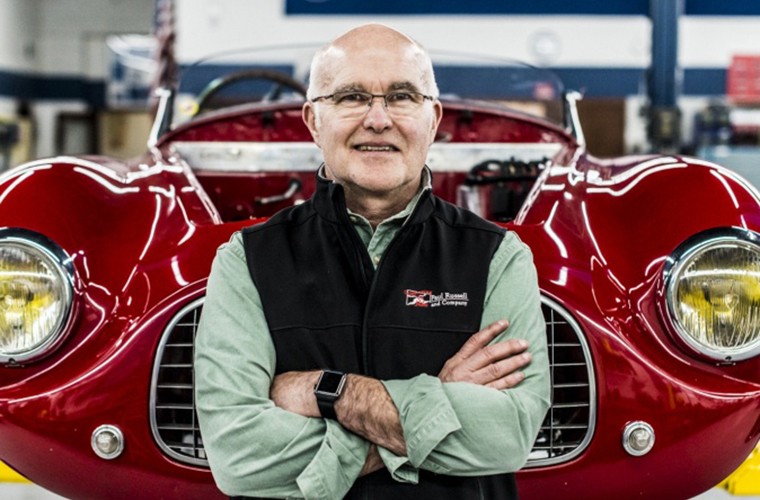

Paul Russell and Company has been specializing in the preservation and sales of 1960s and earlier European classics since 1978.
A small company of twenty-eight craftsmen and support staff operate out of a 38,000 square foot state-of-the-art facility, applying their mechanical, upholstery, body, coach building, machining, parts, and materials experience on Mercedes-Benz, Ferrari, Porsche, Bugatti, Alfa Romeo, and other fine European collectibles.
They consider themselves to be caretakers of automotive history, and, as such, take the time and perform the research needed to determine the best service or restoration approach for each individual car. This attention to detail has resulted in over 45 Best of Show honors, plus numerous other awards and recognitions. Paul is a Chief Class Judge at Pebble Beach Concours d’Elegance, Cavallino Classic, and Ferrari Club of America Nationals; is National Advisory Board Chair for the McPherson College Automotive Restoration Program; and is an active member of the SAE Historic Vehicle Technical Standards Committee, International Chief Judge Advisory Group (ICJAG), International Advisory Council for the Preservation of the Ferrari Automobile (IAC/PFA), and the Society of Automotive Historians. In 2016 he was awarded an Honorary Doctorate of Applied Arts from McPherson College.
Q: How and when did your passion for cars begin?
A: My dad was an engineer who came up through the ranks working in a machine shop in the pulp and paper industry. He started as an apprentice, then worked in the drafting department, then in the design department, and then as head engineer at the company he worked for. We spent time together working in our garage or basement workshop, fixing things around the house, and working on the car. My dad prided himself on teaching me the proper use and care of tools. He also taught me to work to a high standard. I remember him saying, “If you’re not going to do the job right, then don’t even start the job.” He always felt that there was a right way, and then a “don’t bother” way. Those values were deeply instilled in me, and they are also reflected in my business.
I was curious about cars at a fairly young age, and remember walking home from school and peeking inside garages. In high school, a friend’s father owned an Austin Healey, and my friend was allowed to drive it. Riding in that car was a revelation for me, because it was the first time in my life that I realized that cars could be a source of entertainment, and not just for transportation. It was the Austin Healy that sparked my interest in cars, and I vowed I was going to own a Bug-Eyed Sprite at some point, which I eventually did.
Q: When did cars become the focus of your career?
A: I started messing around with cars as a kid, and would buy a few junkers for a couple hundred dollars to make one good car out of the parts. During that time, I was going to college studying civil engineering, and took a side job as a trainee mechanic for small 2-bay independent garage. I enjoyed the work so much that I eventually quit school to work there full time; much to my parents’ displeasure. In making that decision, I remembered an earlier conversation I’d had with my dad in our basement workshop where he had confided that although he had a successful managerial career, that his happiest days had been in the machine shop, working with his hands, as opposed to pushing a pencil. So when he was giving me grief about leaving school, I said, “Dad, don’t you remember telling me how happy you were working at the shop?” He replied, “I didn’t know that you were listening.” I didn’t finish college, but was fortunate to get a good high school education, and did well academically
Q: How did you get started running your own shop?
A: Following my start as an apprentice mechanic, I worked at a BMW dealership and a Mercedes Benz dealership. In the 1970s, those imported cars were all the rage, and the dealerships could not get enough cars to sell. The service shop was seen as a necessary evil, and dealers were not making investments in that area. There were factory schools where they should have been sending young guys to train, but I couldn’t get anyone to send me. It was frustrating.
In 1973, I took a job as a mechanic at a Mercedes restoration shop in Marblehead, Massachusetts that focused exclusively on Mercedes from the 1950s. Restoration work is labor intensive and not all that lucrative, so the owner eventually decided to focus exclusively on buying and selling vintage cars. He split the business and put the restoration business up for sale in 1978, and I raised my hand to buy it. It was a good place to get started in business, and there was already a couple of ongoing jobs in the shop when I took over. We stayed together for 5 years, and at that time I did exclusively mechanical work. Many of my customers wanted a full restoration, so initially we would subcontract out different parts of the job. But that process was too disjointed, too expensive, and took too long to complete a restoration. So we moved to a larger location where we could handle all of the restoration components under our own roof, and some of those subcontractors came to work directly for us. That’s how Gullwing Service Company began to operate as a fullfledged restoration shop.
Q: Craftsmanship is the cornerstone of your business. What’s your definition of that term?
A: Craftsmanship involves skill, combined with the confidence gained from knowing the technicalities of the process you’re undertaking. It also involves a very high level of thoroughness. Craftsmanship starts with competence, but implies a certain level of artistry. The artistic side involves the application of the confidence and thoroughness in a way that is sensitive to the time and history of whatever you are working on. Craftsmanship is instilled as part of the culture of our shop. I frequently hear my staff say, “This is how it’s done here.” They see their work as something that’s unique. There are no shortcuts. The way you build a culture of craftsmanship is by allowing people to do the job properly. It’s a fallacy that there are no good craftsman anymore. The problem is that there aren’t very many places that will tolerate good craftsmanship. They don’t allow craftsmen to do their jobs properly because the thoroughness necessary for craftsmanship to occur requires having the proper amount of time. We believe that if you have enough time to do a task over, then you have enough time to do the task correctly in the first place. We are extremely grateful to have clients who allow us to work to a very high standard. Obviously, price matters to everyone, regardless of how wealthy an individual is. But in the hierarchy of what’s involved in assessing a job, it’s always quality and authenticity first, and cost second. In the long run, clients always come out in a better place owning the best of the best.
Q: You claim to “restrain the urge to make cars like new.” Can you explain that philosophy?
A: n our business, the word “restoration” has many different meanings to people, but most often it implies “better than new.” When we restore a vehicle, first we seek to understand and be sensitive to how and under what circumstances the car was built. Then try to get the car as close as possible to what “new” was really like at the time the car was built, and not better than new. I admit that with our typical restoration of the 80s or 90s, there were some cars that we restored that were better than new, in terms of fit and finish and performance. But we’ve grown in our understanding and appreciation of what an authentic restoration means by continuing to learn how cars were really made, and reeling it in, to restore cars to reflect how they were made to begin with.
Q: The body-off restoration process is extremely complex, involving multiple functions and parts of the car. How do you coordinate all of the physical, financial and client communication tasks?
A: Each car has its own core team, and team members are sometimes on more than one team, but they all have specific roles to play in each project. Each project has a dedicated crew chief, and typically he’s the head mechanic, and who supervises the job. There’s also a chief metalworker, and a body specialist, an upholsterer and parts technician involved in all projects. We also have a production coordinator who helps communicate with clients, and sends them pictures of their car at least once a month. We have regular team meetings to review where we are, and what’s necessary to stay on the time line. We have a full-time tool and die maker, and a team of body guys in the metal shop ready at all times, so that there’s no slack time between departments. With vintage cars that may have had various owners, its hardware has often been changed or lost, and it can be difficult or impossible to put it back together with the same hardware that Porsche or Mercedes used back in the day. So getting the car’s replacement hardware prepared with all the right plating and finishes, and with proper markings on the bolts, is a complex project that has to be accomplished months before the car comes into the mechanic’s area for final assembly. There’s a lot of coordination and communication required for every project. The reason it all works is that we have an excellent, dedicated staff.
Q: Is research regarding a car’s provenance always a part of a restoration assignment, or only when it’s important to the owner?
A: We need to understand the provenance, and it’s always part our restoration process. Provenance is extremely important, and ultimately affects the value of the car. There are diverse aspects to provenance: How many cars did they make? Who made the car? How was it built, in terms of the materials, techniques and technologies used? When was it made? What’s the chassis number? Who owned it? What changes have been made to the car? We have a full-time resource manager who collates all of the research and material that we collect on a car. He puts together the information in a highly usable format that the project team has on the job, so that they don’t have to pore over historic documents. It’s presented to them by categories in a notebook, that we call the “decision book,” which contains some pretty serious minutia regarding every possible aspect of the car. For example, the book will explain what type of stitching should be used on the carpet binding, so that when our upholsterer gets to doing that part of the job, he has all of the information he needs. When a car is completed, all of that information goes into the presentation book for Pebble Beach or other competition. We also put together the car’s “restoration story” in a small hardbound book, so that the owner can enjoy all of the details of the restoration process. This photographic essay, depicting the step-by-step process, documents and validates the authenticity of the car.
Q: Any “words of wisdom” for aspiring vintage car collectors?
A: Many people ask me, “What car should I buy?” which I find to be a strange question. My answer is that people should buy what they love. People also should know, at the outset, what they want to do with the car. Sometimes we have to read between the lines when a customer tells you what he wants. We have a great customer who told us at the outset that he enjoyed driving cars, and was not a “concours guy.” So we recommended a very nice street car, but he kept coming back to fix minor issues with that car. We eventually realized that he was a perfectionist who wanted a 100 point car to drive. He turned out to be a meticulous planner who, in fact, is a “concours guy.” We’ve had cars for him at Pebble Beach for the past 4 years, and he is already working with us on cars he plans to show there over the next 3 years.