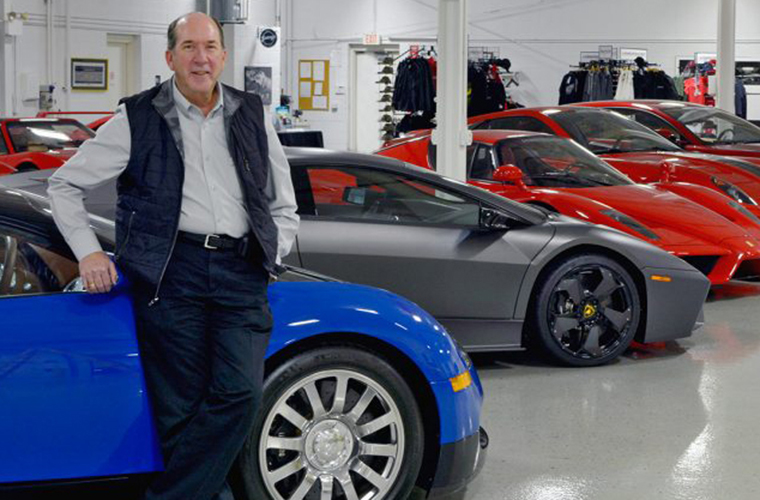


Ken is the owner of Lingenfelter Performance Engineering, which was founded by his cousin John Lingenfelter, the legendary NHRA racing champion. The Lingenfelter Collection includes some of the world’s most significant muscle cars, Corvettes and exotic European automobiles, which Ken shares with fellow enthusiasts at the many charitable events he sponsors throughout the year. Ken dedicated a large portion of his life to building a highly successful title insurance firm that was eventually acquired by a large publicly held company. Unlike many other entrepreneurs, however, Ken chose not to spend the rest of his days enjoying the fruits of his labors. Instead, he increased his activity level; by focusing on making his extensive car collection a platform for charitable giving, and by stepping in as the hands-on owner at Lingenfelter Performance Engineering, which delivers a range of world-class products and services for serious high performance car enthusiasts.
Q: How and when did your passion for cars begin?
A: My dad worked in a GM Fisher Body plant in Euclid, Ohio; frst on the assembly line and then in a management position. Sometimes he would come home for dinner and then take me back to the factory. I was only 5 or 6 years old, and while he was working I would run around the factory and look at the cars. You could never do that today. When I was about 10 years old, he took me to an open house for family members at a GM Tech Center, which was where I frst saw the 1963 split window Corvette. I remember walking right up behind it, and I could not believe what I was seeing. That car almost took the legs right out from under me, and I was hooked. At that moment, I knew that I was going to be a Corvette guy for life, and that’s how it’s turned out.
Q: You ended up building your own highly successful title insurance company. How did that happen?
A: After working for the title company for 5 years, I was encouraged by an older business associate to start my own business. And in 1978, I established The Metropolitan Title Company with myself and two people. That was during a very severe recession, which actually turned out to be a good time to get started. I quickly realized that you needed a very sharp pencil to succeed, and while existing title companies were struggling to stay in business, I was there with a fresh start. We were independent, so after 5 p.m. we were still answering the phone while larger frms were turning off the lights and going home. As my small business grew, I was able to acquire some of the title companies that were going out of business. I also started investing in real estate, and bought some rental houses and one small apartment building. I continued making acquisitions of other title companies well into the early 80s, as the recession dragged on, and interest rates ballooned to 13 – 15%. By the time I sold the company in 2003, we had acquired 90 businesses, and had 3,000 employees operating in 16 different states. It was a sprawling operation, but we succeeded because we had so many talented, hard-working people, and we spent a lot of time training them on the basics and how to get things done properly.
At the outset, I didn’t intend to sell my company, and it happened somewhat organically. The complexities of the business required automation software that was just being developed, and which we did not have. There was one large public company – First American Title – that was a leader in the business, and I approached them to license their automation software for my company. They agreed to sell me their software, but told me they would prefer to buy us out and make my company part of theirs. Our companies had very similar management philosophies and institutional values, so we combined operations and I joined their company as a corporate officer for 5 years. I left that position in 2008, to focus on my roles at Lingenfelter Performance Engineering and my charitable foundation. Our consolidation with First American Title turned out to be a very good decision. They have many great people, and it is still one of the strongest and most respected companies in the industry.
Q: What’s the story behind your decision to take over your cousin’s Performance Engineering business in 2007?
A: John Lingenfelter was a distant relative, who was an internationally recognized NHRA racing legend. John also founded Lingenfelter Performance Engineering (LPE), a small company in Decatur, Indiana that specialized in high performance modifcation of mostly GM vehicles. In 2003, I sold my title insurance business on December 15th, and John passed away on Christmas Day of that same year of some injuries he had sustained in a racing accident in Pomona, CA earlier in the year. After he died, LPE continued, but the company had lost its momentum and spirit. John’s brother Charlie knew of my passion for cars and sought me out. He convinced me that I should step into the business and live out John’s legacy, which is what we did. LPE was very small when I bought it, with perhaps 10 employees. Now we have upwards of 70 people across all our operations working in two shops. That includes Lingenfelter Motor Sports, which is a company that buys and sells collector cars, and the Lingenfelter Collection that helps us with our charity work.
Q: How would you describe the makeup of the Lingenfelter Collection of cars?
A: There are currently about 250 cars in my collection. We keep about 190 cars in the facility here in the Detroit area, and the rest are in other locations in other states. I always describe the collection as 30% muscle cars, 30% exotics, and the balance are Corvettes and some of our old race cars from back in the day when we competed at different events.
Q: You purchase cars based primarily on your personal preferences, rather than anticipated market value appreciation. Is this a good rule of thumb for collectors?
A: My collection consists of cars that I’ve liked, or cars that I always wanted to buy but couldn’t afford at the time. I refuse to overpay for anything, so I’m very careful with the price I pay for a car, regardless of how much I may want it. My strategy has never been based on buying a car solely from an investment standpoint. Having said that, I bought some great Ferraris that have skyrocketed in market value. When I purchased the 288 GTO and F40, it was a stretch for me at the time, but they were not expensive relative to their current price. Those cars turned out to be very good investments, but it was unintentional. I didn’t buy them because I thought they would appreciate in value. I bought those cars because I liked them. You have to follow market values to a certain degree; it would be dumb to overpay for a car simply because you think it’s going to increase in value. You should buy a car because you want to enjoy it. Enjoying a car can mean looking at it. It can mean taking it to car shows. It can mean driving the daylights out of it. It can mean modifying it. Everyone has their own passion with respect to the cars that they want to buy
Q: How did you earn a coveted position on Ferrari’s list of customers?
A: I’ve never asked anyone from Ferrari, “Why do you guys allow me to purchase your super cars?” As most people know, Ferrari is very focused on their brand, as they should be. I think the fact that their cars are on display in our collection, and that we drive them and with the car collection raise funds for charities is important to them. I believe Ferrari feels that we represent their brand well. Common sense rules here. When it comes to buying Ferraris, you buy the ones that are really significant, and the ones that are important. And you don’t do dumb things with their cars. You need to keep buying them. I had the honor of being invited to Ferrari’s 70th birthday party a year ago, and to visit their factory in Maranello. It was a fantastic experience.
Q: As a leading Corvette authority, what’s your opinion of its first mid-engine car?
A: I think the new C8 is absolutely stunning, and its price point is incredible. Every serious Corvette enthusiast I’ve spoken with in the Corvette world is very excited about this car, and thinks it’s amazing. Corvette needed to produce a mid-engine car to remain in racing, and to be competitive. They are studying the demographics. They know there are plenty of older guys like me who have always loved Corvettes. But they need to appeal to a younger group, and their mid-engine car is going to do just that. They hit a home run with the price point. MSRP at the car’s unveiling was $60k, which is going to be a really basic car, but that’s still a lot of bang for the buck, which is always what Corvette has been known for.
Q: Any concern over the Millennial generation’s growing lack of interest in cars that have long been considered classic collectables?
A: We’re living through an evolution in tastes and fluctuations in car values. Although I’ve never used price appreciation as the basis for buying a car, I remain interested in having the cars that I own maintain their value. I don’t want to lose money on the cars that I‘ve purchased. There’s defnitely a demographic shift taking place, with lots of attention being focused on cars from the late 70s, the 80s, and early 90s. That market consists of guys who were growing up during those years, but couldn’t afford to buy those cars; but now they are able to acquire them. Those cars are very popular right now, and I see a lot of interest in them at auctions. Conversely, there is declining interest and value in some older cars that are still really great collectibles. Here’s an example of why this is happening: if you showed up at an auction with a beautiful, original Corvette with matching numbers, it would do very well. But if you resto-mod that same car in good taste – with upgrades to the engine, brakes and overall comfort to drive – it would do much better. People are looking to mix classic styling with modern performance and reliability. I love my 1963 split window Corvette, but I don’t want to drive it 50 miles to a car show. I don’t want to worry about how long it will take me to stop when I hit the brakes. Or fight with the car because it has bias ply tires. Or wonder if the air conditioning will work. Or smell gasoline the entire trip. I’ve been spoiled like everybody else, because cars are so good today. This is a meaningful trend, because the younger generation doesn’t want to be inconvenienced by all of the traditional quirks involved in owning an older car. They want to get in the car, press a button and go…and that’s OK, because that’s what they grew up with. This is having an impact today and will continue to have an impact. It’s not going to destroy the business of buying and selling collector cars, you just have to be more careful.
Q: You conduct several charity events a year. What drives your desire to give back?
A: When the car collection started coming together in the building, my wife and I both realized that it would be really sad to own all these great cars, and not share them with others. We didn’t want the collection open to the public all the time, because that would be too diffcult to manage. So we decided to share them at specific events, and see if people would donate to great charities to see the cars. That’s worked out extremely well. Our foundation is focused mostly on helping kids’ charities, and our biggest recipient is Ronald McDonald House. Sharing the car collection with others continues to be a very rewarding experience for us. It also makes me feel more normal, knowing that there are so many other guys who are as passionate about cars as I am. We’ve conducted as many as 60 charity events in a single year. These events range from formal galas, to pizza & beer get-togethers with car guys, and corporate groups that use the collection for meetings by making a donation to our foundation. We sponsor two really big events each year: the Spring Open House for the American Cancer Society, and the Fall Open House, which benefits The Pink Fund, a breast cancer charity. Our facility has 45,000 square feet of floor space, and we have had crowds as large as 5,000 people at those two events. They are not formal, black tie affairs; it’s just “come as you’re dressed, and donate whatever you want to at the door.” There’s no minimum donation.