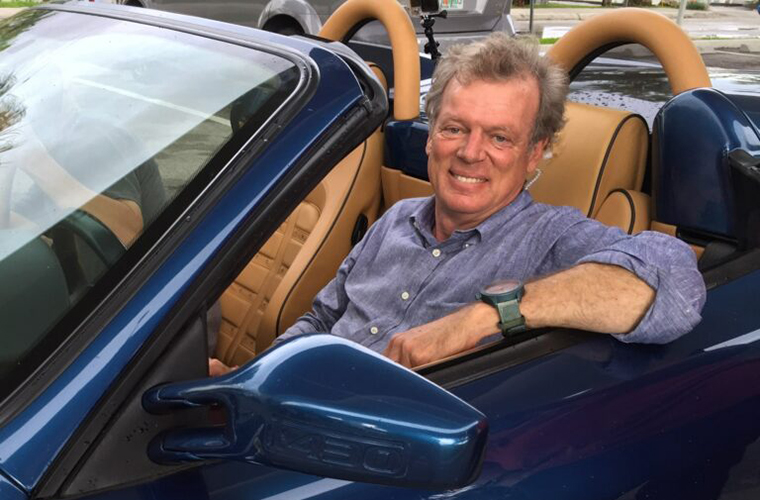


Keith Martin has been involved with the collector car hobby for more than thirty years. As a writer, publisher, television commentator and enthusiast, he is constantly on the go, meeting collectors and getting involved in their activities throughout the world. He founded the monthly Sports Car Market magazine 30 years ago, and it is recognized as the authoritative informed voice of the collector car hobby. Martin’s second publication, American Car Collector, continues to be the fastest growing collector car publication in America.
Q: What sparked your love of cars?
A: My love of all things automotive began as a 3-year-old, straddling the front-end of my grandfather’s Ford 9N tractor, holding on to the radiator cap. He used that tractor to work his 5-acre “gentleman’s farm” north of San Francisco; and for 4 or 5 years, that was how I spent my weekends. Maybe it was the vibration and warmth of the engine, at such a young age, that started pumping the gasoline through my veins.
Q: Is it true that your career path began in modern dance, rather than cars?
A: My career plan has always been based on following my passions. My first and most enduring passion has been sports cars, but as a student at Reed College, under the tutelage of the late professor Judy Massee, I developed a love for modern dance. I also studied dance at Julliard in New York City, and had the honor of working with Martha Graham and Charles Weidman, who are widely recognized as the founding members of the modern American dance movement. After 15 years in the world of dance, and having achieved all of the personal goals I had set, I went looking for a change. My career journey from dance into the world of sports cars involved many twists and turns, rather than a straight, well-planned path. Based on a personal relationship I had established with a large local car dealer (who was a supporter of the arts), I began to sell cars – everything from Ferraris to Chevys – which was the starting point for my transition into a full-time career in the world of sports cars.
Q: How did you move from selling cars to automotive publishing?
A: That’s another example of my serendipitous career path. In the late 1980s, the demand in Europe and Japan for sports cars had skyrocketed, driven by a post-World War II generation that could finally afford to purchase sports cars, and the lack of supply to meet that demand. So I created a sideline business finding, shipping and selling sports cars to buyers overseas. During that (pre-internet) period, there were several subscription-based market newsletters devoted to specific marques, such as Ferrari, Maserati and Porsche, that served as the informational and transactional platform for buyers and sellers. Because there was no existing market newsletter dedicated to Alfa Romeos, I placed an advertisement in Hemmings Market News, and within a short period I had nearly 200 subscription orders. So that initial demand drove the launch of the Alfa Market Letter, and subsequently the English Market Letter, which served as the catalyst for my long-term venture into the automotive publishing world. I saw a market opportunity, stuck my toe in the water, and was in business.
Q: Any macro market trends that collectors should pay attention to?
A: The most notable change is what I see happening at auctions, where late model cars – such as limited production Porsches and Ferraris are in greater demand. There appears to be a new generation of collectors, just hitting their 40s, who have made some money and are entering the market for the first time with very different personal tastes and opinions regarding which cars are most desirable. This new generation of auto enthusiasts appears to be less interested in “classics” such as a Lamborghini Countach or a Ferrari 250 SWB, and much more interested in owning a Porsche GT3 RS or a Ferrari 599. This appears to be part of the normal evolution in market demand for collector cars. There is nothing that can be done to change or fight these trends, so it’s important for collectors to stay informed and to plan and adapt accordingly
Q: Can you offer Baby Boomers any guidelines as they begin to make hard choices about “thinning their collections”?
A: Most people prefer to deny or put off issues related to their own mortality. This can be a problem for auto enthusiasts with collections of any size, because getting rid of a car can feel like sending one of your children away. It’s particularly difficult for Boomers to give up a car, because it’s a final goodbye, and they know they will probably never replace it. We own cars for different reasons. Some for their beauty. Some because they are great drivers. The only advice I can offer for thinning a collection is to keep the one (or ones) that you drive and enjoy the most. I think it’s that simple.