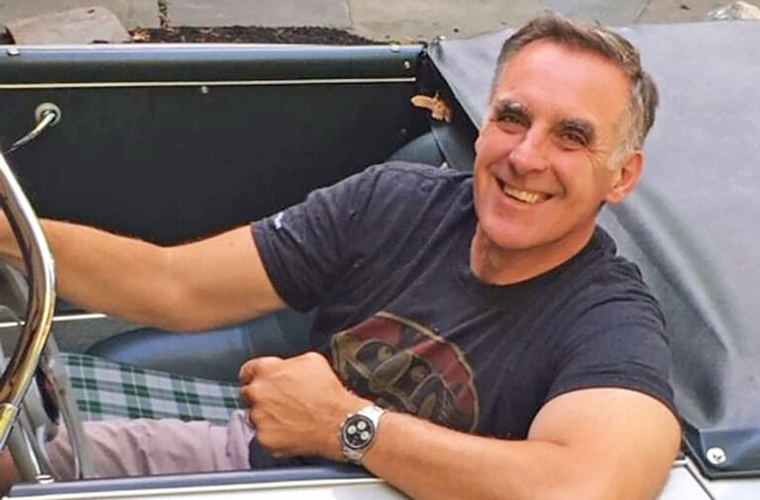

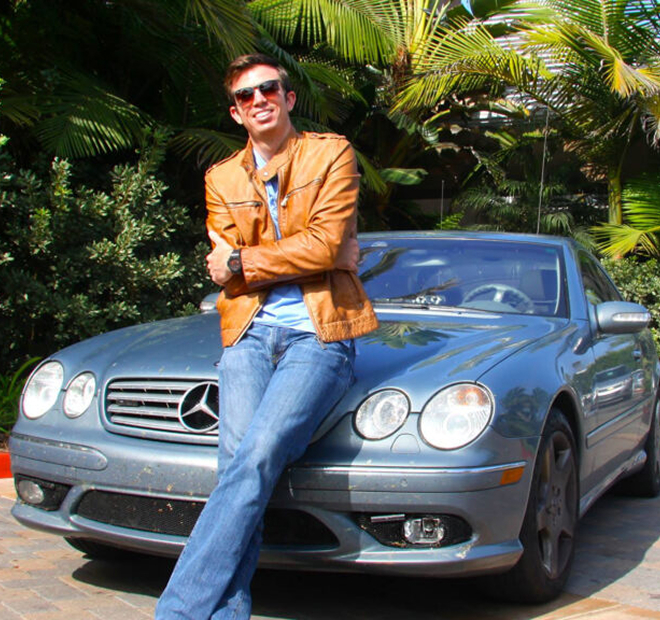
Steve Serio began his career with a side business exporting vintage Aston Martins back to the UK; which led to ownership of a successful Aston Martin dealership. His high-end brokerage business locates, evaluates and purchases rare, multi-million dollar cars.
Q: What’s your back story, and what sparked your love of cars?
A: My dad was not a car guy. He treated cars as transportation, and had a knack for buying less than stellar automobiles. He was a beat cop in Watertown, west of Boston, and would pass by toy stores and come home with Matchbox cars for me. My mom was a travel agent, so I was also exposed to Corgi toys, which were the kings of automotive toys. I still have that toy car collection. We would take family trips to Europe, and to this day I remember being at Lake Como in Italy and seeing a yellow Ferrari Dino 246 with a peacock antenna in the middle of the roof. Those toy cars and that exposure to exotic cars at an early age is what shaped my life-long passion. In fact, I ended up owning a yellow Dino many years later.
Q: How did you get started in the car business?
A: By no means was this car thing planned. I studied photography at Rochester Institute of Technology, then worked at a television station in Boston as a staff photographer, and in 1987 opened a commercial photography studio. I shot for all the Boston magazines, as well as annual reports for public companies, and portraits for peoples’ portfolios; in the trenches doing every kind of photo assignment. During that time, I was also trading 50s and 60s Aston Martins as a sideline business. Then two things happened that redirected my life. The recession hit in 1990, and most of the magazines folded, banks merged, and businesses stopped spending. My photography business died as a result. On the flip side, however, there was a run-up in the classic car market at the same time. From the late 80s into the early 90s, it was like the internet stock craze 10 years later. I got caught up in that, and had a natural place to jump, from photography to the car world. This was not scripted career planning; it was simply a safety net for me.
Q: Why the interest in Aston Martin?
A: My initial affinity for the marque was having grown up watching James Bond movies, and having the Aston Martin Corgi toys. More directly, I had traveled to Europe with friends in the mid80s, and each time had noticed that, because of the exchange rate, there was a big difference between the prices of Aston Martins in the US compared with the UK. When the dollar was at parity with the pound, a lot of Americans had visited England and brought back right-hand drive cars home with them. Then over the years, the currencies shifted to where the pound was almost 2-to-1 compared with the dollar, and there were a lot of used Aston Martins languishing in the US. I had always liked the car – DB4s, DB5s and DB6s – so I went around the country collecting cars that no one cared about, and shipped them back to England. I found a guy in London to work on the cars, and another person to sell them, and for several years my car business was exporting, or rather re-importing, Aston Matins back to the UK. That was the basis for the Aston Martin dealership I have now.
Q: How does one get to be (according to Bloomberg) in the “top tier of an elite network of consultants and experts who buy and sell most of the world’s bluechip vehicles”?
A: I started my brokerage business because I loved cars. There was no road map to follow. My membership in that “elite network” is based on two things. First, over the past three decades, I’ve purposely avoided the liars, cheats, thieves and weasels who’ve operated in the car business. Probably 90% of those people don’t exist anymore, so I’ve outlasted them. The second and more important factor is that I’ve been able to find and align myself, personally and professionally, with around 10 people from across the globe who know where all the dead bodies are buried. They’ve all been in the trade for decades, and some of them operate under the radar. They are bona fide authorities on rare cars; some are the historians who write the books about specific marques. They are a very tight group of guys who can find almost any car in the world in less than 48 hours. You can hand one of them a million dollars in cash to help build a collection, and a month later they might ask you, “Do you want your million dollars back?” They are knowledgeable and trustworthy, and we talk.
Q: How do ultra high net worth car collectors find you?
A: Clients find out about me by word of mouth, and it’s generally by referrals from a tight knit group of people I know or do business with. One client, for example, who I’ve helped put together an extensive Porsche collection, was referred to me by a mechanic who’s a longtime friend. A longtime classic car friend, who was someone I met when I was a commercial photographer, had a friend’s son cut his grass, who eventually became successful in private equity, and then he became a very good client as well. A lot of my business involves being in the right place at the right time, and I would always rather be lucky than good. I might call people in my network, and ask, “Can you help me find a McLaren F1 for this much money,” and they will call me a week later and say, “Didn’t you tell me you were looking for a McLaren F1?” It’s sounds goofy and almost trite, but it’s all about doing business with the people you trust and respect.
Q: What’s with your @therealbondgroup Instagram handle? How much of a real-world impact does being featured in a James Bond movie have on a particular car?
A: In fact, the name for my car brokerage business – The Real Bond Group – has nothing to do with James Bond. It relates to the bond of friendship with a group of guys who I do business with. Aston Martin can certainly be most thankful for James Bond, and Lotus can be as well. It’s added to great appeal in marketing over the years, as people have gotten older and wanted their own Aston Martin. You have guys my age who have a DB5, a DB9 or a DB11, and some of them have V8 Vantages. In fact, I have a huge poster in my showroom of Sean Connery leaning up against his DB5. I don’t think the BMW Z3 or Z8, or the Mustangs and Citroens have benefitted from any James Bond knock-off effect. In the new Bond movie, which has been delayed for release until the fall, there is a DB5, a V8 or regular Vantage from the 80s, so Aston Martin should continue to benefit from product placement.
Q: You’ve said there’s a paradigm shift in the collector car world, in terms of what cars are most desirable. Please explain.
A: I didn’t think the next group of guys coming up would be as rabid and enthusiastic about cars as my generation. What I neglected to consider, perhaps because I was being a bit snotty, is that there is a big world of serious collector car people out there; they just don’t happen to be driving cars that I care about. The cars from the 50s, 60s and early 70s – that I have built my career selling – are going to have to take a back seat to cars from the 80s, 90s and early 2000s, that the younger guys are buying now. They want to buy the cars of their youth. As this happens, I honestly believe that I am aging out of the business. This paradigm shift is leaving me in the dust, which is why I need to constantly reinvent how to remain relevant in the business. For example, I’m getting involved with Porsche race cars through Cam Ingram at RoadScholars. But the big shift that’s taking place involves guys in their 40s, who are putting hypercar collections together. That’s not me. You don’t call me to get a Koenigsegg, a Bugatti Chiron or an FXX Ferrari, because I have no passion for those cars. I can’t talk the language, and I don’t know the small nuances in the marketplace or the models. I can accept that. I don’t understand why someone wants a Mitsubishi, or would pay $100k or a Toyota Supra, but there’s a whole generation of enthusiasts who would, because that’s what they grew up on.